🚀 Launch Your MVP & Get a Free 5-Page Marketing Website – Limited Time Offer!
Claim Your Free Website

How AI Enhances No-Code Scalability
App Development
Created:
Dec 22, 2025
Updated:
Dec 22, 2025
How AI boosts no-code scalability with automatic autoscaling, data cleaning, context-aware automation, faster MVPs, and cost-effective monitoring.

AI is transforming no-code platforms by addressing scaling challenges like handling surges in users, growing datasets, and complex workflows. Unlike traditional automation, AI-powered platforms analyze context, make decisions, and optimize performance automatically. Key benefits include:
Smarter automation: AI handles repetitive, complex tasks, saving time and improving efficiency.
Data processing: AI cleans and organizes data, tracks changes, and ensures models stay accurate over time.
Performance scaling: Platforms automatically adjust resources during high demand, reducing costs and maintaining speed.
For example, Remote’s AI-driven IT system saves 600+ hours monthly by automating ticket management, and AI tools helped a company cut churn by 15% through tailored onboarding. AI also enables non-technical users to build and scale applications faster by simplifying workflows and reducing reliance on engineering teams.
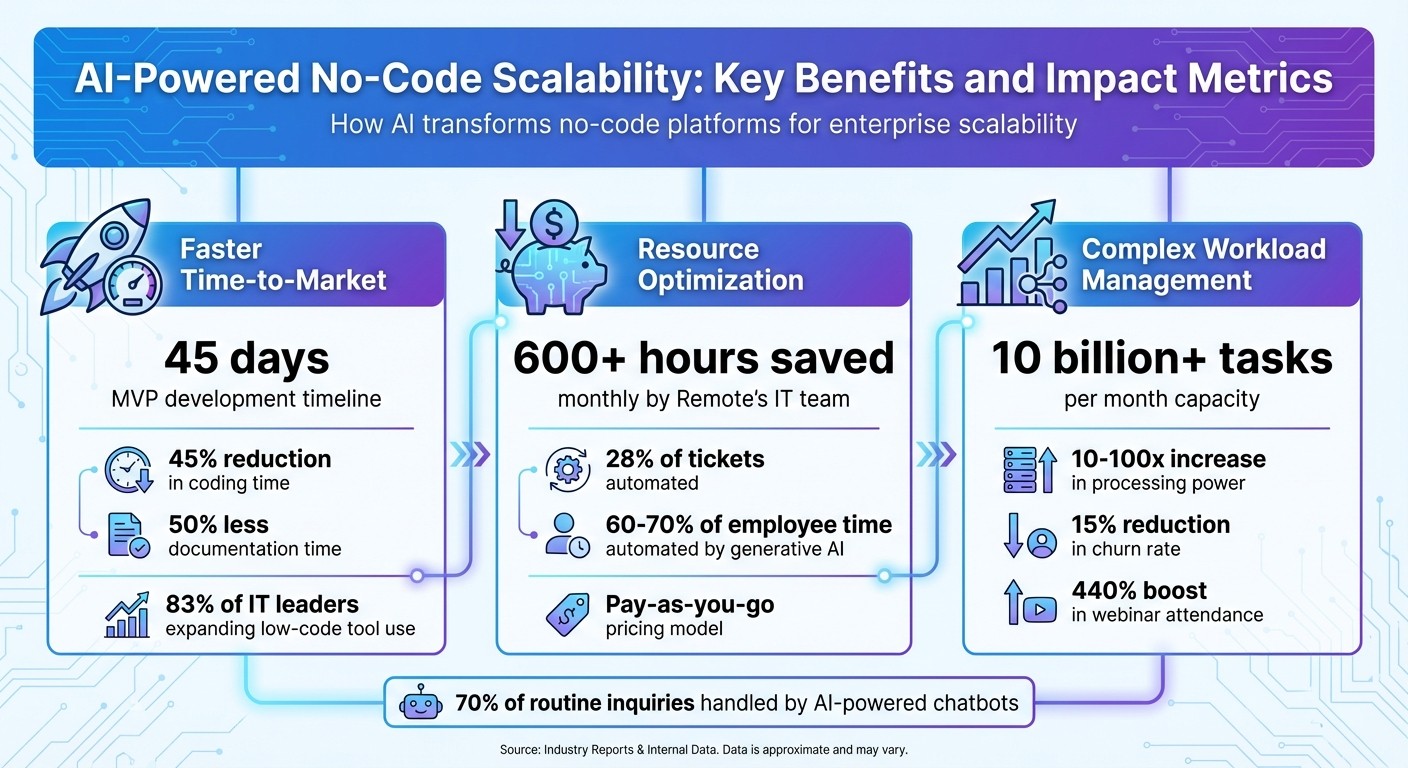
AI-Powered No-Code Scalability: Key Benefits and Impact Metrics
AI Features That Enable No-Code Scalability
Automated Infrastructure Scaling
AI takes the hassle out of scaling your resources by handling it automatically. When traffic surges, AI-powered platforms adjust capacity in three key ways: duplicating your application to handle more requests (horizontal scaling), increasing the CPU and memory of your current resources based on usage trends (vertical scaling), and provisioning new virtual machines when your hardware reaches its limits (infrastructure scaling).
This kind of autoscaling can lead to impressive results - processing power can increase by 10 to 100 times for high-demand tasks compared to traditional setups. For example, platforms like Google Cloud's GKE use real-time metrics, such as CPU usage or request rates, to determine when scaling is needed. Even for resource-intensive tasks that require specialized hardware like GPUs, AI ensures these are only activated when necessary and deactivated once the job is done, helping you avoid extra costs.
AI-Driven Data Processing and Management
As your data grows, AI steps in to keep things clean and organized. It removes duplicates, eliminates outdated records, and corrects errors - all in the background, ensuring your database remains accurate and reliable.
AI also tracks "data drift", which happens when changes in data patterns reduce the accuracy of predictive models. For example, a no-code AI chatbot once managed 80% of customer support tickets before needing updates due to external API changes. The takeaway? AI doesn't just store data; it actively monitors for shifts and alerts you when it's time to retrain your models.
Performance Optimization Through AI Automation
Traditional automation relies on rigid rules, but AI introduces context-aware automation that adapts to your workflows. Nicole Replogle from Zapier highlights this evolution:
"AI orchestration is the end-to-end coordination of data, tools, and AI models so each step of a business process triggers the next without human hand-offs".
AI-powered automation streamlines processes by prioritizing tasks, categorizing data, and enriching information in real-time. This eliminates manual handoffs, reduces operational costs, and boosts efficiency.
Modern platforms leverage serverless execution and event-driven designs to handle massive workloads - scaling up to 10 billion+ tasks per month - without requiring manual capacity planning. This approach ensures your application scales seamlessly as demand grows, keeping performance steady without wasting resources. These automation tools are the backbone of scalable no-code solutions powered by AI.
How to Implement AI for Scalable No-Code Solutions
Selecting a No-Code Platform with AI Capabilities
The first step in implementing AI for no-code solutions is choosing the right platform. Focus on three main factors: the variety of AI models it supports (like natural language processing, predictive analytics, or computer vision), its ability to integrate with external tools, and whether it allows for easy switching of models to avoid being tied to a single vendor.
It’s important to match the AI model to the specific task at hand. For instance, some models are better suited for processing long documents and code, while others excel in natural language tasks or handling multimodal inputs like images and text together. Once you’ve identified the right platform, the next step is to ensure your data is prepared to meet the AI’s requirements.
Preparing and Uploading Data for AI Processing
After selecting the platform, your focus should shift to preparing your data. Clean, organized data is key to ensuring the AI works accurately. Before uploading, address common issues like inconsistent naming, duplicate records, and missing fields, as these can disrupt the AI’s ability to process information effectively.
Centralizing your data into a single source of truth is equally important. Using no-code tools for data management can help avoid conflicting information from multiple sources. For example, visual formulas like the concatenate() function can combine data points - such as campaign objectives and target audiences - into a single, cohesive input for the AI.
Here’s a real-world example: In 2025, a company struggling with a 25% churn rate implemented an AI workflow to tag new signups by language, standardize data formatting, and automatically enroll users in tailored onboarding sessions. This resulted in a 440% boost in webinar attendance and a 15% drop in early churn rates.
Training and Deploying AI Models Without Code
Modern no-code platforms make training AI models straightforward with drag-and-drop tools. You simply select the model type, connect your data, fine-tune the parameters, and let the platform handle the training and deployment process.
Before deploying the model organization-wide, run pilot tests in a controlled environment. Using real inputs in a sandbox setting helps identify edge cases and ensures the model performs as expected. Some platforms even offer "prompt-to-app" features, where describing your needs in plain language can generate a working prototype - complete with a user interface, database, and hosting. This approach can dramatically cut down on development and documentation time.
Scaling and Monitoring Solutions with AI
Once your AI solution is live, it can take over tasks like monitoring performance and adjusting resources automatically. Track key metrics such as tasks completed, time saved, accuracy, and cost per task to measure ROI and identify areas for improvement.
To prevent unexpected costs, set up alerts to monitor usage. Incorporate error-handling workflows to manage failures gracefully, and include human oversight for sensitive outputs. This ensures your system can scale effectively without sacrificing quality or security.
Iterating and Optimizing for Long-Term Scalability
Success in the long run requires ongoing improvements. Establishing a Center of Excellence (CoE) can help centralize expertise, standardize benchmarks, and create reusable components, which prevents duplication of efforts and maintains consistent quality.
Optimize your databases by indexing key data, normalizing tables, and scheduling routine cleanups. Use caching and CDNs to reduce server loads and improve performance. Retrieval-Augmented Generation (RAG) techniques can also enhance AI accuracy by pulling verified data from your existing knowledge bases, reducing the risk of incorrect or irrelevant outputs. Finally, conduct regular audits of your AI models to ensure they remain compliant and accurate.
Benefits of AI-Enhanced No-Code Scalability
Faster Time-to-Market and Iteration
Traditional AI development can feel like a marathon - months of intricate steps before seeing results. But with AI-powered no-code platforms, that marathon becomes a sprint. The process is simplified into just four steps: collecting data, using drag-and-drop tools for training, analyzing results, and integrating workflows. What used to take months can now be done in hours or days.
This speed becomes even more valuable when it’s time to iterate. Instead of waiting on developers to implement changes, business users can tweak workflows visually and redeploy on the fly. For startups and businesses testing new features or reacting to market changes, this rapid feedback loop is a game-changer. With 83% of IT leaders planning to expand their use of low-code tools, it’s clear that faster deployment cycles are becoming the norm. And when you can prototype quickly, you’re not just saving time - you’re laying the groundwork for smarter resource use and lower costs.
Cost Savings and Resource Optimization
AI-enhanced no-code platforms deliver financial benefits in two key areas: cutting labor costs and boosting operational efficiency. By removing the need for specialized data science teams, these platforms empower existing staff - IT managers, analysts, and operations teams - to build and manage complex applications themselves. Generative AI, in particular, automates tasks that often eat up 60%–70% of employees’ time, freeing up resources for higher-value activities.
Take Remote’s IT team, for example. With just three people, they managed to handle 1,100 monthly support tickets by using ChatGPT to automate classification and prioritization. The result? 28% of tickets were automated, saving over 600 hours each month.
The financial model also shifts. Instead of hefty upfront investments and high salaries for specialists, businesses can adopt flexible, pay-as-you-go pricing. Maintenance costs drop too, as visual updates replace manual coding, and AI-assisted debugging catches potential issues early. Combined with speed and efficiency, this approach ensures that even the most complex workloads are managed effectively while keeping costs in check.
Handling Complex and High-Demand Workloads
AI-enabled no-code platforms aren’t just fast and cost-efficient - they’re also built to handle complexity. These platforms excel at interpreting unstructured inputs like emails, documents, and text, areas where traditional rule-based systems often fall short. This capability becomes vital as workloads grow more varied and demanding. Modern integration platforms, for instance, manage over 10 billion tasks per month, effortlessly adapting to unpredictable traffic patterns.
"AI helps you proactively recognize things to improve in real time." - Eric Shih, Director of Product Management, Salesforce
The benefits go beyond raw processing power. AI works behind the scenes to clean up data, detect duplicates, and streamline manual processes into dynamic workflows. For example, ActiveCampaign used AI to tackle a 25% churn rate caused by poor onboarding. By automatically tagging new users by language and enrolling them in tailored webinars, they achieved a 15% reduction in early churn and doubled product adoption within 90 days. This kind of intelligent, context-aware automation scales seamlessly, handling increased demand without the need for additional staff or infrastructure. It’s efficiency, amplified.
Building a Scalable No-Code Backend with Xano
Building Scalable MVPs with 918 Studio's AI-Powered No-Code Solutions
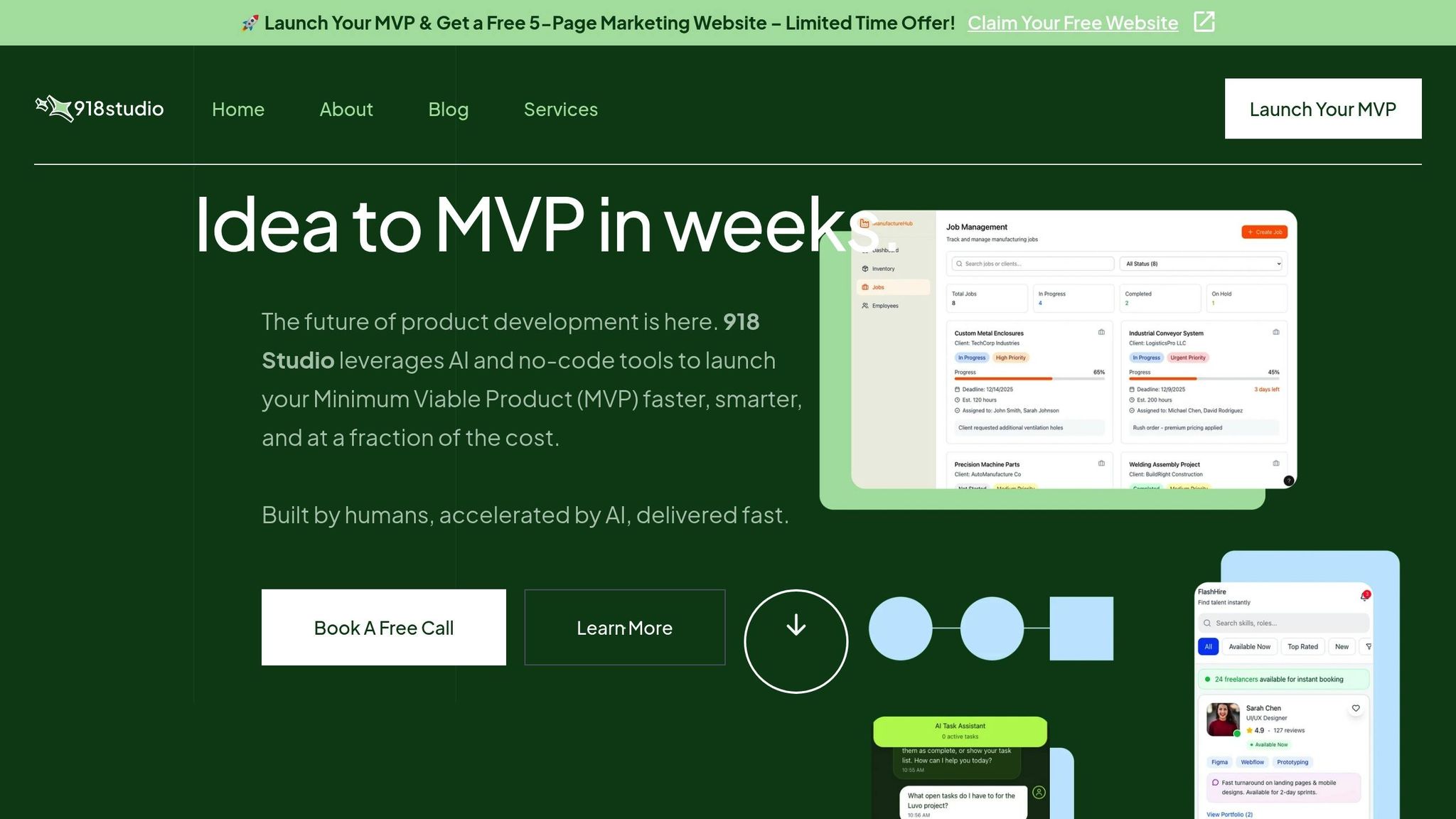
918 Studio takes MVP development to the next level by combining AI-driven automation with no-code platforms, enabling faster development and seamless scalability.
AI-Driven MVP Development in 45 Days
918 Studio has reimagined the MVP development process, condensing it into a 45-day timeline. By integrating AI with no-code and low-code platforms, the studio drastically reduces the time spent on repetitive tasks like setting up database connections, API endpoints, and authentication systems - all while maintaining strong security protocols. This streamlined approach slashes coding time by 45% and cuts documentation time in half.
Using natural language processing, 918 Studio transforms plain English requirements into structured development plans. For instance, a request like "help users find products quickly" can evolve into a fully functional autocomplete system paired with recommendation engines. AI-powered prototyping tools also create interactive mockups, simulating user behavior to validate ideas early and avoid costly revisions down the line. As 918 Studio explains:
"AI speeds up time-to-market by eliminating bottlenecks".
Custom Scalable SaaS, Apps, and Tools
From SaaS platforms to mobile apps, web applications, and AI dashboards, 918 Studio develops scalable solutions tailored to business needs. By leveraging AI code generation, they turn simple descriptions into complete functions and modules, ensuring consistent coding patterns across projects. This consistency simplifies maintenance and scaling as businesses grow.
For more complex requirements, the studio uses a hybrid low-code approach, allowing developers to fine-tune AI-generated code without slowing down the process. AI-powered chatbots handle 70% of routine inquiries, while automated testing tools identify potential performance issues - like memory leaks or inefficient database queries - before they affect users. According to the studio:
"The frontend is what users see, touch, and experience. No-code tools allow us to iterate quickly, but AI enhances that experience - optimizing UI/UX, automating workflows, and predicting user behavior for a seamless, intuitive product".
This approach ensures that every product is not only functional but also user-friendly and adaptable.
Ongoing Support and Growth Optimization
918 Studio's involvement doesn't end at launch. The studio provides continuous support, updates, and scaling services to help businesses grow. AI-powered DevOps tools automate CI/CD pipelines, enabling faster rollbacks and precise deployments. Dynamic resource allocation, driven by historical and real-time data, adjusts resources as needed to control costs and ensure efficiency.
To maintain long-term scalability, the studio monitors AI models for "data drift", ensuring that features remain accurate as user data evolves. This forward-thinking approach allows businesses to focus on innovation while 918 Studio handles the technical complexities required for sustainable growth.
Conclusion
AI-powered no-code platforms are reshaping how businesses scale. Rather than hiring more staff to handle increasing workloads, companies can automate tasks like triaging support tickets, enriching sales leads, and personalizing onboarding workflows. Modern AI tools now take on activities that typically consume 60% to 70% of employees' time, allowing teams to focus their energy on strategic, high-impact decisions.
The results speak for themselves. Businesses using AI workflows have reported saving over 600 hours per month in IT operations and cutting early churn rates by 15% with smarter onboarding systems. These numbers highlight the measurable advantages of integrating AI into no-code platforms.
"Agentic AI doesn't replace the human role, it amplifies it, letting people spend time on the highest-leverage decisions instead of repetitive execution." - Albert Santalo, Founder and CEO, Archie Labs
As discussed, balancing rapid deployment with sustainable growth is essential. 918 Studio’s approach addresses this challenge head-on. While no-code platforms enable fast product launches, scaling successfully requires more than just speed - it demands robust infrastructure practices like performance monitoring, model drift detection, and integration audits. By delivering AI-powered MVPs in just 45 days and supporting ongoing improvements, 918 Studio ensures businesses are equipped for both immediate success and long-term scalability.
Whether you're building a SaaS platform, a mobile app, or an internal tool, combining AI with no-code development offers a winning formula. This approach accelerates time-to-market, boosts operational efficiency, and provides the flexibility needed to manage complex, high-demand workloads as your business grows. With this integrated strategy, companies can not only launch efficiently but also stay ahead by continuously optimizing as they scale.
FAQs
How does AI help no-code platforms scale effectively?
AI plays a key role in expanding the capabilities of no-code platforms by taking over repetitive tasks, simplifying workflows, and enhancing overall performance. These smart systems are built to process large amounts of data with ease, cutting down on manual work and keeping operations running smoothly, even as demand increases.
With AI in the mix, businesses can scale up quickly and efficiently without breaking the bank. From automating routine processes to refining data management and boosting performance, AI-driven no-code tools empower organizations to respond to shifting needs swiftly, all while maintaining high standards of quality and speed.
How does AI improve data processing in no-code platforms?
AI is revolutionizing how no-code platforms handle data by automating intricate tasks and turning raw information into meaningful insights - no coding required. With AI, teams can automatically collect, clean, and organize data from sources like CRMs, spreadsheets, and support systems in real time. This not only saves countless hours of repetitive work but also helps cut down operational expenses.
Thanks to advanced capabilities like machine learning and natural language processing (NLP), AI can even manage unstructured data - think emails or scanned documents - and make context-aware decisions that get smarter over time. This paves the way for businesses to build sophisticated tools like dashboards, chatbots, and predictive workflows, enabling teams to scale more quickly and concentrate on high-priority strategies. AI-powered no-code solutions, such as those offered by 918 Studio, give startups and enterprises the ability to implement scalable, budget-friendly systems that adapt as their needs evolve.
How can businesses scale efficiently with AI-powered no-code platforms, even without technical expertise?
AI-powered no-code platforms are making it easier than ever for businesses to scale their operations - no technical expertise required. These platforms rely on user-friendly tools like drag-and-drop builders, pre-trained AI models, and built-in integrations. With these, users can quickly create automated workflows, data pipelines, and tailor-made applications without breaking the bank. The result? Faster development, lower costs, and scalable solutions such as chatbots, analytics dashboards, and dynamic pricing systems.
Here’s how businesses can dive into this technology:
Pick the right platform: Look for one with AI-driven features that can recommend algorithms and automatically fine-tune settings to fit your needs.
Establish a Center of Excellence (CoE): Assign a team to oversee reusable components, governance, and staff training to ensure smooth implementation and long-term success.
Use visual editors: Build workflows effortlessly with visual tools that trigger AI-powered actions like sentiment analysis or anomaly detection.
For example, platforms like 918 Studio combine AI-powered no-code and low-code solutions to help businesses roll out scalable products - whether it’s an MVP, a SaaS tool, or a data dashboard - quickly and cost-effectively.
Related Blog Posts

Contact us
913-214-2703