🚀 Launch Your MVP & Get a Free 5-Page Marketing Website – Limited Time Offer!
Claim Your Free Website

Questions to Ask Before Hiring No-Code Agencies
App Development
Created:
Jan 26, 2026
Updated:
Jan 31, 2026
Essential questions to vet no-code agencies—covering platforms, team, costs, timelines, scalability, IP ownership, and post-launch support.

Agency Expertise: What low-code MVP development platforms do they specialize in (e.g., Bubble, Webflow, Glide)? Do they have certifications, case studies, or experience with custom coding and integrations like Stripe or OpenAI?
Workflow and Team: How will they manage your project? What does their quality assurance process look like? Who will work on your project, and will they be dedicated to it?
Costs and Timelines: What pricing model do they use (fixed price, hourly, or retainer)? What’s included in the cost? How long will the project take, and how do they handle delays or changes?
Scalability and Maintenance: Can the solution grow with your business? What’s their approach to post-launch support, and who owns the intellectual property?
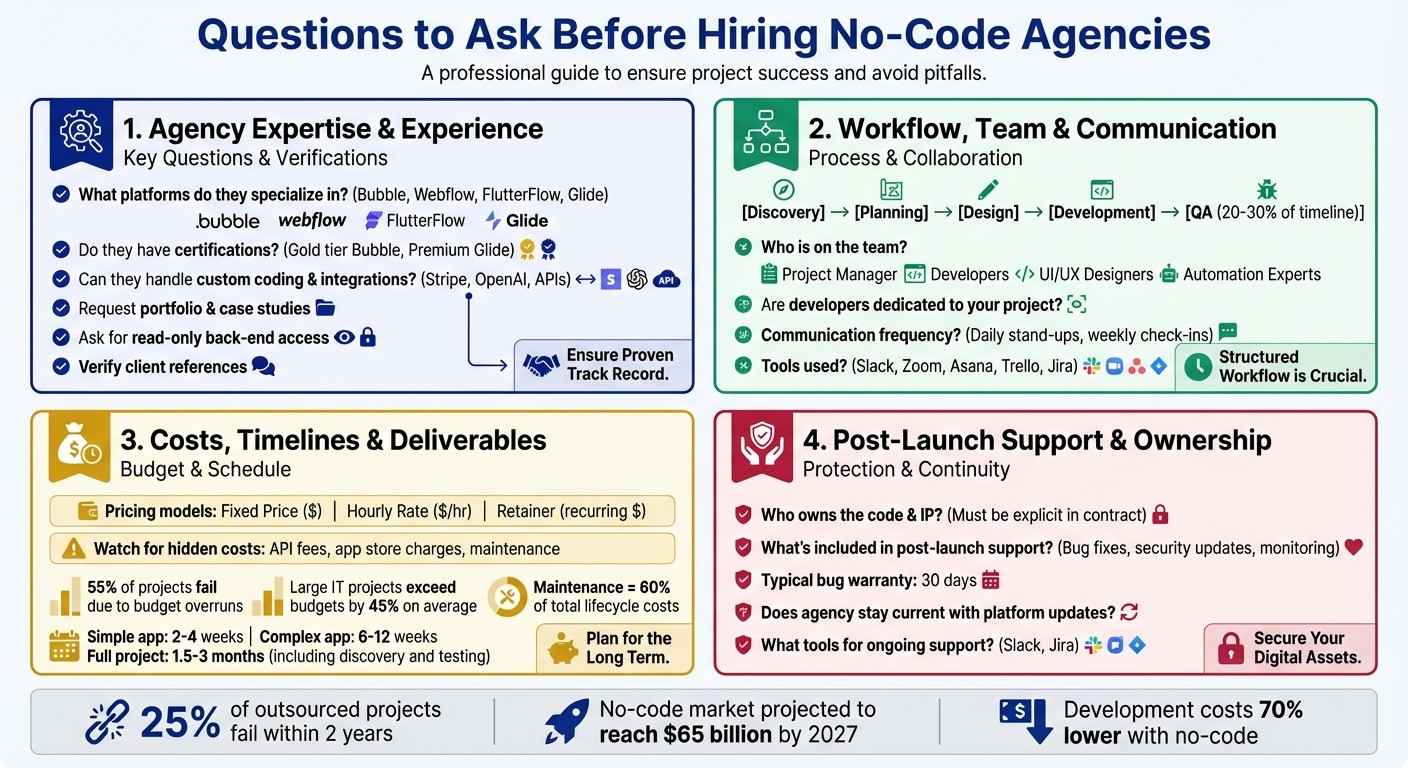
Essential Questions to Ask Before Hiring a No-Code Agency
How to Build a No Code Agency from Scratch - Zubair Lutfullah Kakakhel | EP 04
Questions About Agency Expertise and Experience
The platform an agency specializes in and their track record can significantly influence your product's success. Start by asking which platforms they work with and how they determine the best fit for your project. Many agencies focus on specific tools: Bubble for building complex web apps and SaaS platforms, FlutterFlow for mobile apps with a native feel, Webflow for creating high-performance marketing websites, and Glide for crafting data-driven internal tools. The right choice will depend on how no-code development is transforming SaaS MVP launches and the specific scale of your project. Once you've identified their preferred tools, confirm their expertise by reviewing certifications and case studies.
Certifications and integration experience are key indicators of an agency's skill level. Look for developers with credentials like "Gold tier" on Bubble or "Premium" on Glide. Additionally, confirm they can handle custom coding for situations where no-code platforms might fall short. Ask for examples of third-party integrations they've implemented - such as integrating Stripe for payment processing or OpenAI for AI-powered features.
Request to see their portfolio or case studies that showcase technical depth, not just aesthetic appeal. For instance, in 2025, LowCode Agency developed an MVP for RentFund using Glide in just four weeks. The platform simplified rent payments between tenants and landlords, helping the startup secure investments and reach a $3 million valuation. They also created an offline-capable app for RedZone using FlutterFlow, designed to streamline sewer inspections. This app reduced work order completion times by 40% and improved data accuracy by 80% by eliminating manual entry.
Beyond certifications, dig deeper into their technical approach. Ask for a read-only back-end link to inspect their work. If they use platforms like Webflow or Bubble, check for an organized database structure and clear class naming conventions (e.g., "container" instead of "div-block-437") - these details ensure scalability. It’s also worth contacting clients mentioned in case studies to verify the agency's reliability, including whether they deliver projects on time and within budget.
For AI-driven projects, evaluate how to launch your MVP in 45 days with no-code and AI while ensuring the agency handles error management and API interactions effectively. Ask how they manage AI errors and deal with partial or unexpected API responses. A professional agency will design systems with built-in failure states and monitor token usage and API costs. Jesus Vargas, Founder of LowCode Agency, emphasizes this point:
"A good low-code AI app developer does not just 'add AI.' They design systems where AI fits naturally into how teams work every day".
Questions About Workflow, Team, and Communication
How Does the Agency Approach Development?
Getting a clear picture of an agency’s workflow helps you understand how they’ll handle your project from start to finish. Most agencies follow an agile framework that includes discovery, planning, design, development, and quality assurance - with milestones to track progress along the way.
Pay close attention to their quality assurance (QA) process. This phase typically involves test pre-analysis, mapping expected and error scenarios, and building test matrices. QA often accounts for 20% to 30% of the total project timeline, but this upfront effort can significantly reduce post-launch maintenance costs. It’s also a good idea to ask for their "Definition of Done", which outlines clear criteria for project completion.
For example, in April 2025, NerdHeadz - a gold-tier Bubble development agency - used this agile approach to tackle complex projects like Dispatch Trux and SalesPipe. They placed a strong emphasis on discovery sessions and continuous QA to ensure the final products met client expectations.
Who Will Be Working on Your Project?
Once you understand the workflow, it’s crucial to know who will be working on your project. Ask about the team members and their expertise. Typically, agencies assign a multi-disciplinary team that includes a project manager, no-code developers, UI/UX designers, and automation experts. The project manager acts as your main point of contact, handling communication, timelines, and budgets.
Make sure the no-code developers have strong platform-specific skills and, if necessary, custom coding abilities. Certifications, such as being a Bubble-certified developer or a Webflow Expert, are signs of their technical proficiency. Also, confirm whether the developers will be dedicated solely to your project or juggling multiple clients, as divided focus can affect quality.
Matt Varughese from Agency 8020 highlights the importance of foundational skills for developers:
"I think databases are the fundamental piece of being a well-rounded no-code developer".
What Are the Agency's Communication Practices?
Effective communication is key to keeping your project on track. Ask how often they provide updates - whether through daily stand-ups, weekly check-ins, or bi-weekly progress reports. It’s also worth knowing which tools they use. Many agencies rely on platforms like Slack or Microsoft Teams for messaging, Zoom for video calls, and task management tools like Asana, Trello, or Jira.
Find out if you’ll have direct access to developers or if all communication will go through the project manager. Additionally, confirm whether they offer a discovery phase before development begins. This step ensures your vision aligns with their technical approach.
NerdHeadz emphasizes the importance of a unified approach:
"A no-code agency often brings together project management, design expertise, and technical know-how under one roof. This unified approach ensures smooth collaboration, clear communication, and a streamlined process".
Questions About Costs, Timelines, and Deliverables
What Does the Pricing Include?
Understanding what you're paying for is key to avoiding budget surprises. Agencies generally follow one of three pricing models: Fixed Price (a set fee for a specific scope), Hourly Rate (Time and Materials), or Retainer (a recurring monthly fee). Each model has its pros and cons - fixed pricing offers predictability but limits flexibility, while hourly billing allows for adjustments but can spiral if the scope isn’t tightly managed.
It’s a good idea to request a detailed breakdown of costs, separating one-time development expenses from ongoing fees like hosting, third-party integrations, and software subscriptions. Watch out for hidden costs such as API fees (e.g., Stripe, Zapier, AWS), app store submission charges, and post-launch maintenance after the warranty period ends. Industry stats show that budget overruns are a major issue: 55% of project managers cite them as a leading cause of failure, and large IT projects often exceed budgets by 45% on average.
Be sure to clarify what’s included in the agency’s post-launch warranty - most offer around 30 days of bug fixes. It’s smart to allocate a buffer for unexpected changes based on early user feedback. Remember, ongoing maintenance and support can account for as much as 60% of a software product’s total lifecycle costs.
Laying out clear pricing details upfront also helps set realistic expectations for timelines.
What Are the Expected Timelines?
Timelines vary depending on how complex your project is. For instance, a simple no-code app might take 2–4 weeks, while more intricate apps with features like user accounts and payment systems typically need 6–12 weeks. Including all phases - discovery, scoping, and testing - most projects take around 1.5 to 3 months to launch.
Agencies often use one of two approaches to manage timelines: Fixed-Scope/Fixed-Price, which locks in costs and deadlines upfront, or Fixed-Capacity/Iterative, which allows for flexibility during the build. The latter can lead to cost increases of 50–100% but gives you room to refine features as the project progresses. Common delays stem from adding new features mid-project ("feature creep"), migrating data from older systems, or integrating complex third-party tools.
"The temptation to keep adding 'just one more feature' is what kills most no-code project timelines." – Glance
To keep things on track, make sure all your content - like text, images, and videos - is ready before development begins. Adding a 25% time buffer to initial estimates can also help cover revisions and unforeseen technical challenges.
Getting your costs and timelines right is essential for ensuring your platform can grow alongside your business.
Can the Solution Scale as Your Business Grows?
Scalability is just as important as cost and timing when planning for long-term success. Modern no-code platforms are designed to support scalable applications. Check that the agency uses scalable architecture, modular designs, and thorough documentation to ensure your solution can evolve with your business.
It’s also worth asking how the agency manages scope changes or challenges during future development phases. See if they offer a maintenance retainer or post-launch support to handle performance tracking, bug fixes, and feature updates. Starting with a Minimum Viable Product (MVP) on a single platform - whether mobile or web - can help validate your concept before expanding. Keep in mind that scaling to multiple platforms simultaneously can increase development time by 30–50%.
"Don't budget for the best-case scenario. Budget for the second version." – Olga Gubanova, Ptolemay
Questions About Post-Launch Support and Maintenance
The work doesn’t end once you launch your MVP. Post-launch support is just as important as the initial development phase. After all, ensuring your app stays functional and aligned with your business goals requires ongoing attention and care.
Who Owns the Code and Intellectual Property?
Paying for development doesn’t automatically mean you own the code. Under U.S. copyright law, the developer retains ownership unless your contract explicitly states otherwise.
"The person who pays for development doesn't automatically own the intellectual property unless it's explicitly stated in the contract." - Glance
Make sure your contract spells out exactly what you’ll own - this includes source code, design files, graphics, and documentation. It’s also a good idea to request regular backups and access to development repositories, like GitHub, during the project. Keep in mind that many modern apps rely heavily on open-source components, which can make up 70% to 90% of the code. While you can’t own open-source code, you should receive proper licenses to use it. If proprietary frameworks are involved, the agency may retain ownership but grant you a perpetual, royalty-free license for your project.
Once ownership is clarified, the next step is ensuring you have a reliable plan for post-launch support.
What Support Is Available After Launch?
Post-launch support ensures your app remains stable and adapts to your business’s changing needs. Most agencies offer services like bug fixes, security updates, and performance monitoring to catch and resolve issues before they escalate. This could include keeping tabs on SSL certificates, DNS propagation, and uptime to avoid disruptions.
As your business grows, you might need new features or integrations with tools like Stripe or Zapier. Agencies can also assist with setting up analytics tools like Google Analytics and Google Search Console to track user behavior and search performance. They may provide documentation, training, and automated backups to help you manage your app effectively.
Ask whether you’ll work with a dedicated support team or the original developers. Also, request a "Website Owner's Manual" or similar guide for handling basic tasks on your own. If needed, see if the agency can create sub-user accounts with limited permissions so your team can make small updates without technical help.
Finally, confirm whether post-launch support is included in your package or billed separately.
How Does the Agency Stay Current with Technology?
Technology evolves quickly - especially no-code platforms - so it’s essential to choose an agency that keeps up with updates, security patches, and integration changes. Many agencies offer ongoing maintenance to ensure your app stays secure and functional, monitoring platform updates to address potential issues before they affect your product.
Maintenance can account for as much as 60% of an app’s lifecycle costs. Ask if the agency provides a post-launch bug warranty - typically for 30 days - to address any immediate issues. Also, check whether they assist with app store submissions when updates from Apple or Google impact your app’s performance.
Lastly, find out what communication tools they use for post-launch support. Platforms like Slack or Jira can make it easier to report bugs or request updates. An agency with strong technical expertise and a proactive approach to platform changes will help ensure your app remains reliable and adaptable over time.
Conclusion
Choosing the right no-code agency starts with asking the right questions. Focus on four key areas: expertise, communication, scalability, and ongoing support. Why is this so critical? Industry data shows that about 25% of outsourced projects fail within two years. This makes a thorough vetting process not just important, but essential.
Take a close look at potential agencies. Review their portfolios for evidence of strong technical skills and innovative problem-solving. Use discovery calls to assess their communication style and soft skills. And don’t stop there - reach out to past clients to get a sense of how reliable the agency is, especially during post-launch phases. These steps can help you avoid costly mistakes.
Also, pay attention to the fine print in your contract. Make sure it explicitly grants you full ownership of intellectual property, including the code, design files, and documentation. As mentioned earlier, ongoing maintenance is key to protecting your investment. Confirm whether post-launch support is part of the package or comes with additional costs. You’ll also want to know how the agency handles platform updates and security patches to keep your product running smoothly.
The no-code market is expected to hit $65 billion by 2027, with development costs potentially 70% lower. But those savings won’t mean much if your agency can’t deliver a solution that’s scalable and easy to maintain. Ask detailed questions about how they manage technical debt, plan for integrations, and handle long-term maintenance. These conversations now can save you from major headaches down the road.
Ultimately, the right agency is more than just a vendor - they’re a strategic partner invested in your success. By evaluating their expertise, workflows, ownership terms, and support offerings, you can find a partner who aligns with your long-term goals. At 918 Studio, we pride ourselves on following these principles to deliver solutions that aren’t just effective but built to last. The right agency can transform your vision into a reality, ensuring your project thrives for years to come.
FAQs
What should I ask to assess a no-code agency's expertise?
To gauge a no-code agency's expertise, start by exploring their past work. Ask for case studies or examples of projects similar to yours. This will help you see if they’ve successfully delivered solutions that match your needs. You can also reach out to their previous clients for references to get a sense of their professionalism and dependability.
Be sure to discuss their experience with specific no-code platforms like Bubble, Webflow, or FlutterFlow, especially if your project relies on one of these tools. This confirms they have the technical know-how to meet your requirements. Don’t forget to ask how they handle more complex aspects, like advanced features, scalability, or integrations. These elements are often crucial for larger or more intricate projects. By focusing on these factors, you’ll have a clearer picture of whether they’re the right agency for your goals.
What should I consider about an agency's project management style before hiring them?
When you're considering a no-code agency, their project management style can make or break the experience. A solid agency will have clear communication channels, well-organized workflows, and a system for providing regular updates. This ensures you stay in the loop and aligned with the project's objectives from start to finish.
You’ll want an agency that prioritizes transparency by openly sharing key details like milestones, timelines, and progress reports. Bonus points if they employ agile methodologies or other flexible frameworks. These approaches allow for iterative development, making it easier to adapt the project based on your input along the way. This not only minimizes risks but also helps ensure the final product aligns with your vision.
In the end, a strong project management approach hinges on three key elements: clear communication, transparency, and flexibility. These qualities set the stage for a smooth and productive collaboration.
What should I ask to ensure my no-code solution is scalable and future-ready?
To make sure your no-code solution can grow alongside your business, start by asking the agency about their track record in building applications designed for scalability. Specifically, find out how they create flexible architectures that allow for adding new features or managing increased user demand as your needs evolve.
You’ll also want to dig into their approach to data management, automation workflows, and integrations. These elements play a big role in keeping your application running smoothly as it scales. Be sure to ask if they follow industry best practices and work with platforms that are built to handle growth, so your solution stays aligned with both your business goals and advancing technology.
Related Blog Posts

Contact us
(913) 308-8878