Architecture Before Aesthetics
Before we touched design, we mapped the structure. Not wireframes — structure.
We defined pillar pages first. MVP Development. AI Product Development. Startup App Development. Ongoing Development. Then we layered in audience pages: Founders, Non-Technical Founders, Agencies, Fractional CTOs, Business Owners, MBA Founders, Internal Tool Development.
Each page wasn't just a piece of content. It had a role inside an ecosystem. We mapped how authority would flow between them. We defined which pages support others. We made sure nothing would become an orphan. Internal linking wasn't left to chance — it was designed deliberately.
Most websites are collections of pages. We built a connected system.
That decision is what makes the SEO strategy coherent instead of scattered.
Choosing a Framework That Protects Performance
We built the site with Astro for one reason: control.
Astro defaults to shipping minimal JavaScript. That matters. Marketing sites often feel fast in development and slow in production because too much front-end weight accumulates over time. Framework decisions compound.
By starting with a static-first architecture, we ensured performance wasn't something we had to "optimize later." It was built into the delivery layer.
Astro gave us clean HTML output, component isolation, and flexibility without the typical JavaScript bloat that plagues many marketing builds.
Performance isn't magic. It's structural.
AI as an Execution Multiplier — Not a Replacement for Thinking
We used AI heavily during this build.
Cursor (running Claude Opus 4.6) accelerated component scaffolding. It helped translate structured architecture docs into real pages. It allowed us to spin up reusable layouts quickly. It dramatically reduced build time.
But here's the critical nuance:
AI did not design the system.
Humans defined:
- The positioning
- The SEO architecture
- The internal linking structure
- The authority flow
- The conversion logic
AI executed against that structure. Without structure, AI creates noise. With structure, it creates leverage.
That distinction is central to how we build for clients as well. AI is an amplifier — not a strategist.
Shipping Hardcoded First, Optimizing Second
There's a tendency in modern builds to overengineer from day one. CMS integration, dynamic content layers, complex abstractions — all before validating flow.
We intentionally did the opposite.
We shipped the full architecture as hardcoded routes first. Every pillar page. Every audience page. All internal links. All metadata. This allowed us to test:
- Page flow
- Conversion hierarchy
- Lighthouse performance
- Heading structure
- Authority mapping
Only after validating the system did we layer Sanity in for blog management.
Speed comes from removing unnecessary abstraction early.
Sanity as Structured Content Infrastructure
When we integrated Sanity, it wasn't to "add a blog." It was to build a structured content engine.
Each blog post is tagged intentionally. Categories have SEO descriptions. Every post reinforces a pillar page. There's no random publishing.
Content clusters matter.
The blog isn't there to create noise — it exists to strengthen authority around MVP development, AI products, startup builds, and fundraising alignment.
This is how content compounds.
Clean Deployment Matters More Than People Think
The site is deployed through GitHub into Vercel.
Every commit is version-controlled. Every deployment has a preview environment. Every rollback is predictable.
Marketing shouldn't feel fragile. It shouldn't feel like pushing a button and hoping nothing breaks.
CI/CD pipelines aren't just for SaaS products. They should power your marketing infrastructure too.
Reliability builds confidence internally and externally.
Performance Is a Strategic Advantage
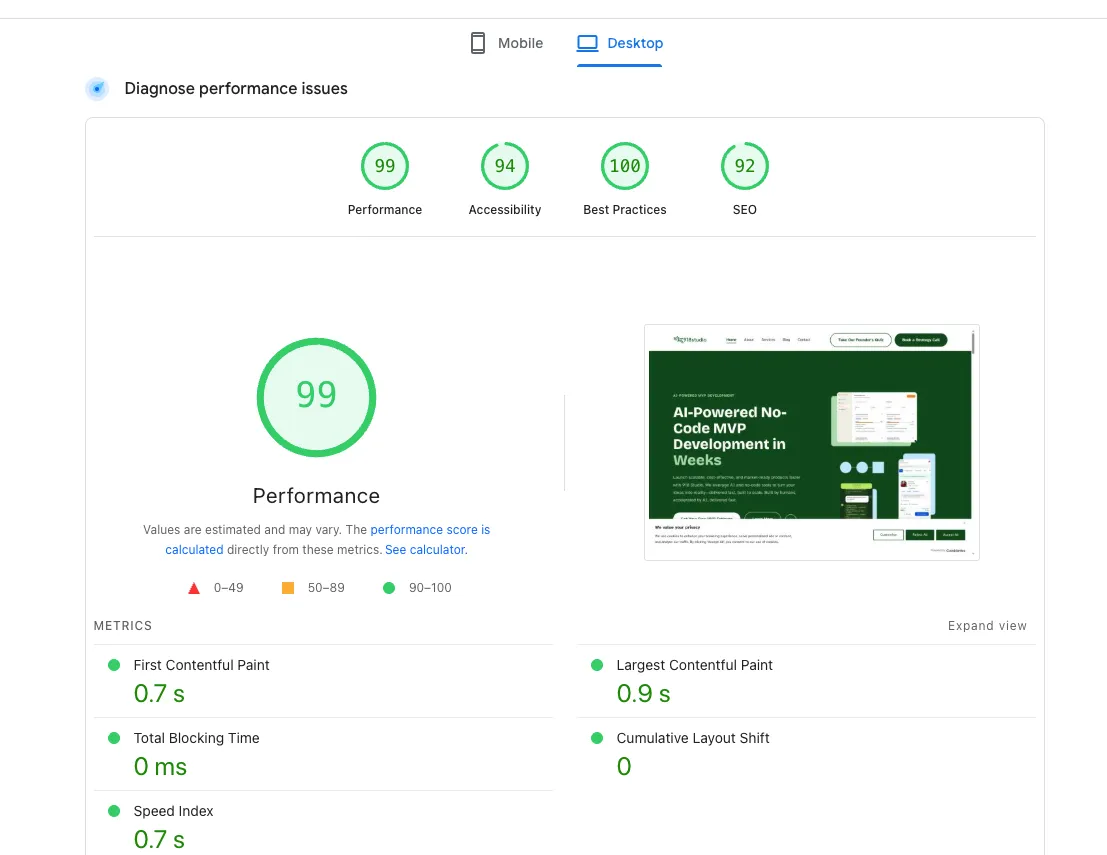
Those Lighthouse scores aren't vanity metrics. They represent structural decisions:
- Minimal blocking time
- Fast Largest Contentful Paint
- Zero layout shift
- Semantic HTML
- Logical heading structure
Performance affects how users feel when they land on your site. It affects search ranking. It affects bounce rate. It affects conversion.
Slow sites erode trust subconsciously. Fast sites signal competence.
We didn't "optimize" into a 99 score. We architected into it.
Internal Linking Was Designed, Not Accidental
One of the most overlooked components of SEO is internal linking.
Most sites accumulate links organically. Ours were mapped deliberately.
Every pillar page supports another pillar. Audience pages push authority back upward. Blogs reinforce core services. No page floats in isolation.
Search engines interpret structure. Users feel clarity.
This isn't keyword stuffing. It's intentional architecture.
What This Means for Founders
If you're building an MVP or launching a startup, the lesson isn't that you should use Astro or Vercel.
The lesson is that structure precedes speed.
When you define architecture first, execution accelerates naturally. When you treat your marketing site like a product, it becomes an asset — not decoration.
And when you combine modern AI tooling with disciplined thinking, you move dramatically faster without sacrificing quality. That's the real takeaway.
Behind the Build
Our office is at 43 Kansas Ave., Kansas City, KS 66105 — and we work with clients everywhere. Our workflow is remote-first and architecture-driven.
This marketing site isn't a side project. It's proof-of-process. It reflects how we approach:
- MVP development
- AI product builds
- Investor-ready architecture
- Performance-first systems
- Lean execution
We believe your marketing site should demonstrate how you think. This one does.